
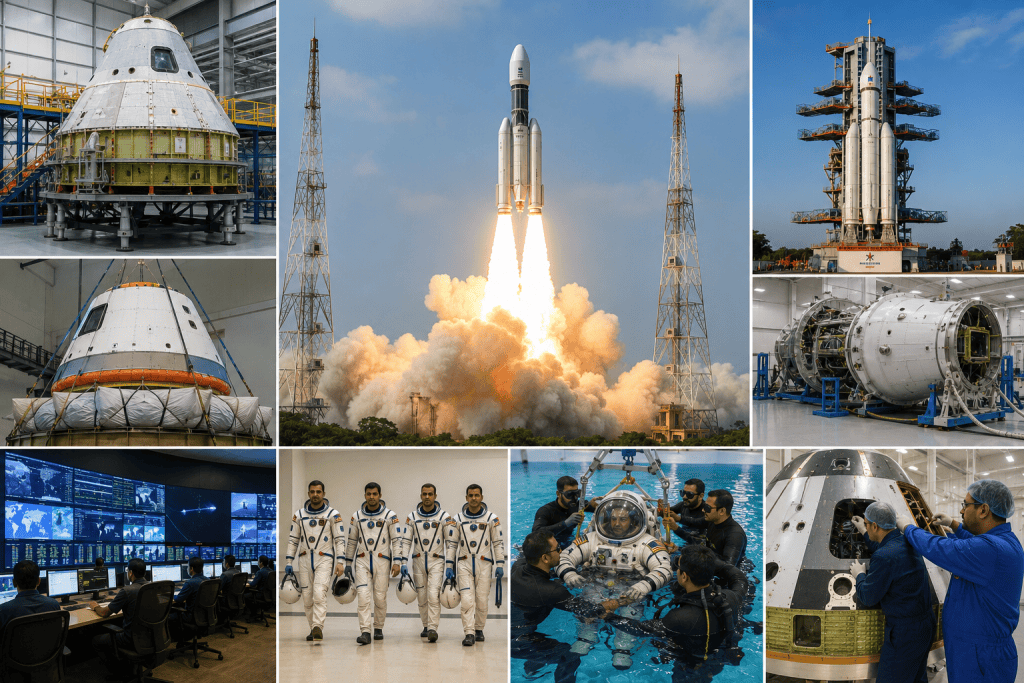
India’s human-spaceflight programme is entering a decisive phase. The Gaganyaan space progress story is no longer limited to plans and concepts; major propulsion systems, crew-module technologies, escape systems, astronaut training, and ground infrastructure have moved through testing and qualification.
The Gaganyaan space progress mission is designed to demonstrate India’s ability to send astronauts into low-Earth orbit and return them safely. The latest government updates indicate that work is progressing toward the first uncrewed mission, while the first crewed flight remains targeted for the first quarter of 2027, subject to the success of remaining tests.
From Ambition to Preparation
The Gaganyaan programme represents India’s most ambitious human-spaceflight effort so far. It requires the country to develop not only a powerful launch vehicle but also a spacecraft, life-support system, crew escape mechanism, astronaut training programme, recovery network, and mission-control infrastructure.
Unlike a conventional satellite missions, the Gaganyaan space progress is a human mission leaves almost no room for technical uncertainty. Every major system must be tested under conditions that imitate the dangers of launch, spaceflight, re-entry, and recovery. This is why the programme has advanced through a series of carefully planned qualification tests rather than a single launch attempt.
Human-Rated Launch Vehicle
A major milestone in the Gaganyaan space progress programme is the development of the Human-Rated Launch Vehicle Mark-3, or HLVM3. The vehicle is based on the LVM3 configuration and has been adapted to meet the stricter safety requirements of human spaceflight.
The government has stated that development and ground testing of all major HLVM3 propulsion stages and structures for the Gaganyaan space progress have been completed. The HS200 booster, L110 liquid stage, C32 cryogenic stage, and motors linked to the crew escape system are among the crucial elements prepared for the next stage of the mission.
Crew Module Takes Shape
The Crew Module is the spacecraft in which Indian astronauts will travel. Its systems must protect the crew from vibration, extreme temperatures, pressure changes, radiation, and the intense heat generated during atmospheric re-entry.
The Service Module will provide propulsion, power, and other essential support during the Gaganyaan space progress mission. According to official updates, propulsion systems for both the Crew Module and Service Module have been developed, tested, and qualified, while their assembly, integration, and testing activities are nearing completion.
Safety Remains the Priority
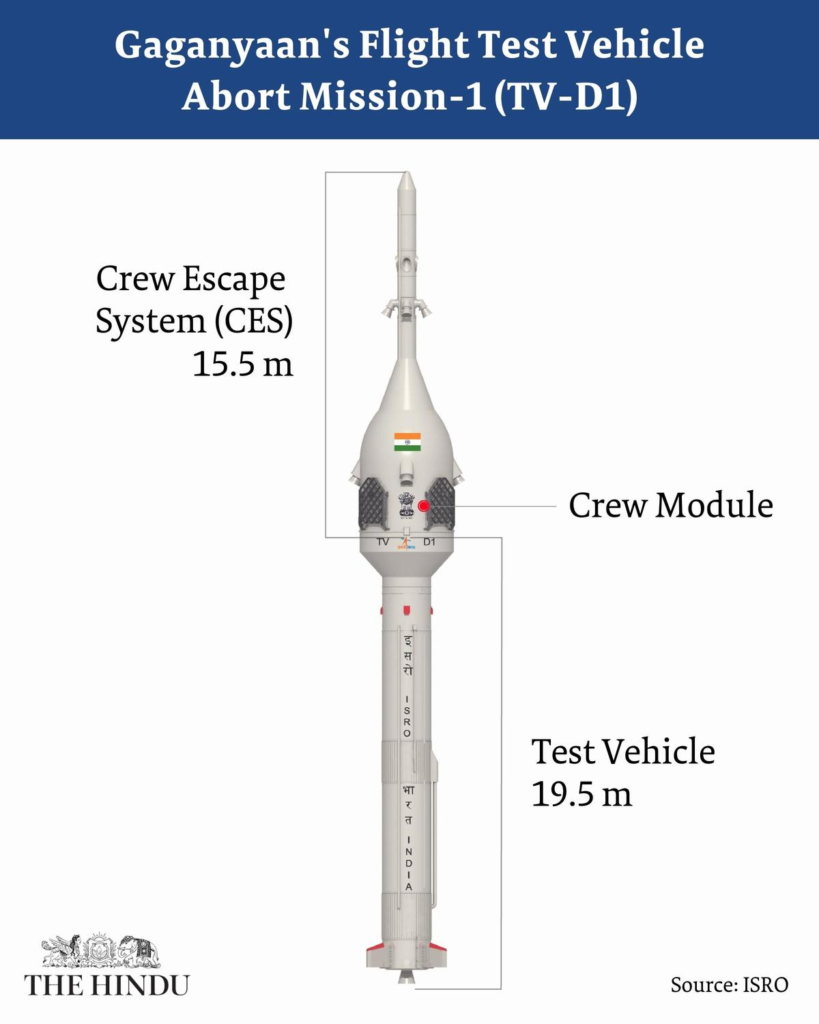
The most important part of the Gaganyaan space progress may be the work being done to protect astronauts if something goes wrong during launch. The Crew Escape System is designed to pull the crew module away from the rocket during a serious emergency.
ISRO’s TV-D1 test mission successfully demonstrated an in-flight abort scenario, validating key aspects of the escape system. Additional work has also focused on parachute recovery, deceleration systems, thermal protection, and the mechanism that helps the crew module return in a stable position after landing.
Astronauts and Ground Support
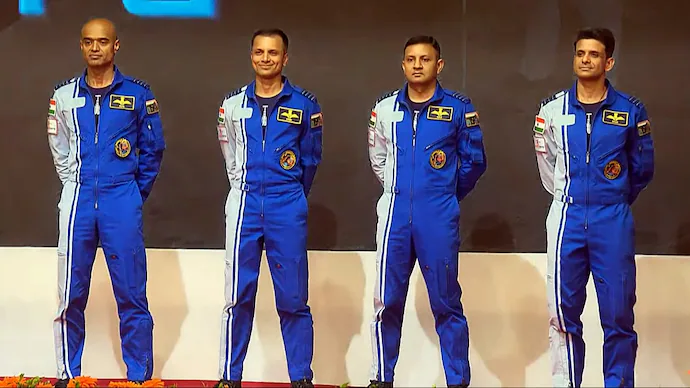
Human spaceflight depends on the readiness of the astronauts as much as the readiness of the rocket. The selected astronaut-designates have been undergoing training that includes physical conditioning, technical instruction, emergency procedures, mission simulations, and survival preparation.
At the same time, India has established important support facilities, including the Gaganyaan Control Centre, crew-training infrastructure, an Orbital Module Preparation Facility, and a strengthened launchpad setup. Ground communication links and recovery assets are also being prepared to support the mission from liftoff to landing.
The Road to the First Crewed Flight
The next major step in the Gaganyaan space progress programme is the first uncrewed mission, known as G1. This flight will allow ISRO to evaluate the complete human-rated launch vehicle, spacecraft systems, recovery arrangements, and mission operations without astronauts on board.
Further uncrewed missions and integrated simulations are expected to provide additional confidence before people are placed inside the spacecraft. The government has reiterated that the first crewed mission is targeted for the first quarter of 2027, but that schedule depends on the successful completion of all safety-critical tests.
The significance of Gaganyaan extends beyond one launch. A successful mission would strengthen India’s position in human spaceflight, expand domestic aerospace capabilities, and create a foundation for future projects such as the Bharatiya Antariksh Station.
For India, the journey is as important as the final countdown. Each engine test, parachute trial, astronaut-training session, and simulation brings the country closer to a historic moment when Indian astronauts could travel to space aboard an Indian spacecraft and return safely to Earth.
-RITOBROTA BANERJEE
MUST READ: The Alien Files Revealed: Shocking Truths About the Pentagon’s UFO Documents
