
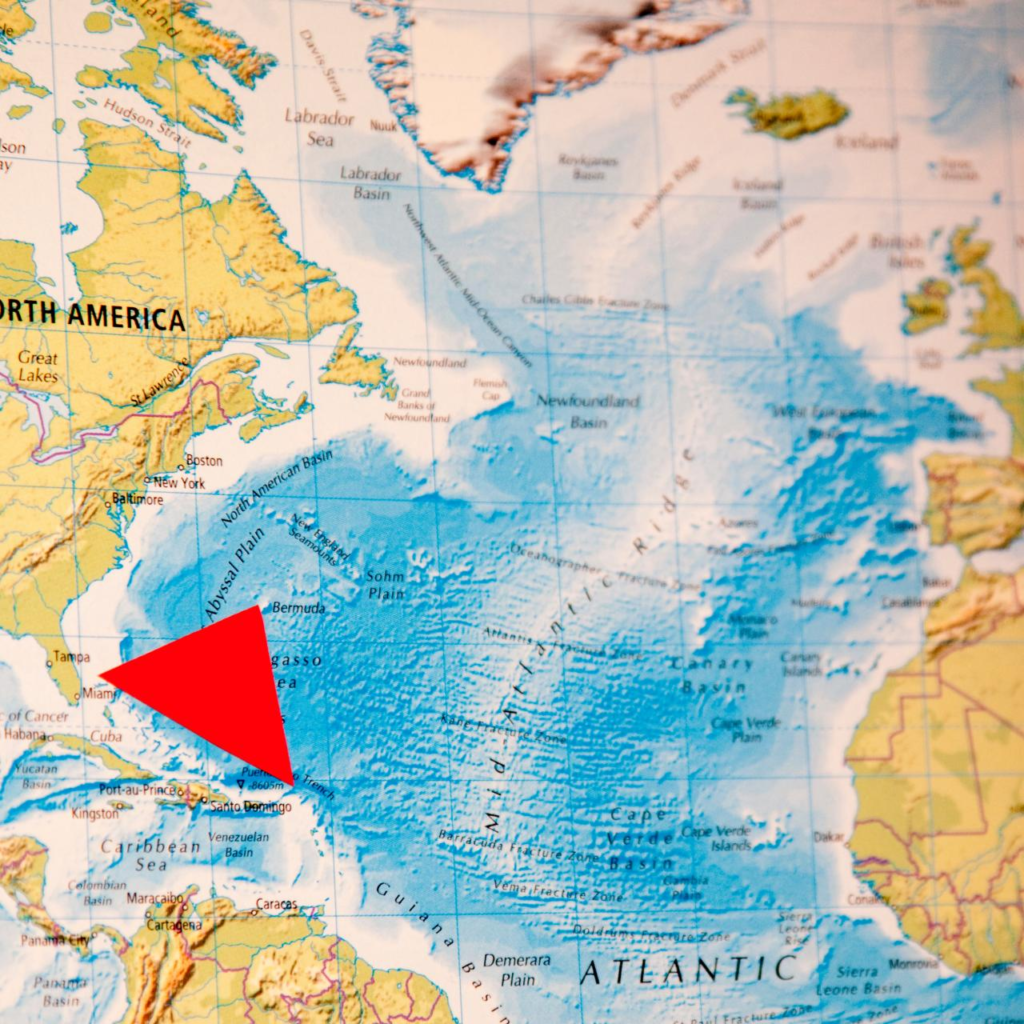
What if an aeroplane vanished without leaving a single trace? What if a ship disappeared from one of the busiest oceans on Earth? For decades, the Bermuda Triangle has inspired fear, fascination, and endless debate.
Introduction
For decades, the Bermuda Triangle has fascinated explorers, scientists, sailors, pilots, and curious minds around the world. Tales of ships vanishing without a trace, aircraft mysteriously disappearing, malfunctioning compasses, and unexplained events have transformed this region into one of the greatest mysteries of modern history. Popular books, documentaries, movies, and conspiracy theories have further strengthened its reputation as a place where the impossible seems possible.
But is the Bermuda Triangle truly a place of supernatural forces, or has its legend been shaped by misunderstandings and sensational stories? While some incidents remain unexplained due to the lack of evidence, scientific research suggests that many disappearances can be explained by natural phenomena, challenging weather conditions, and human error. The Bermuda Triangle therefore stands at the fascinating intersection of science, history, and folklore.
Where is the Bermuda Triangle?
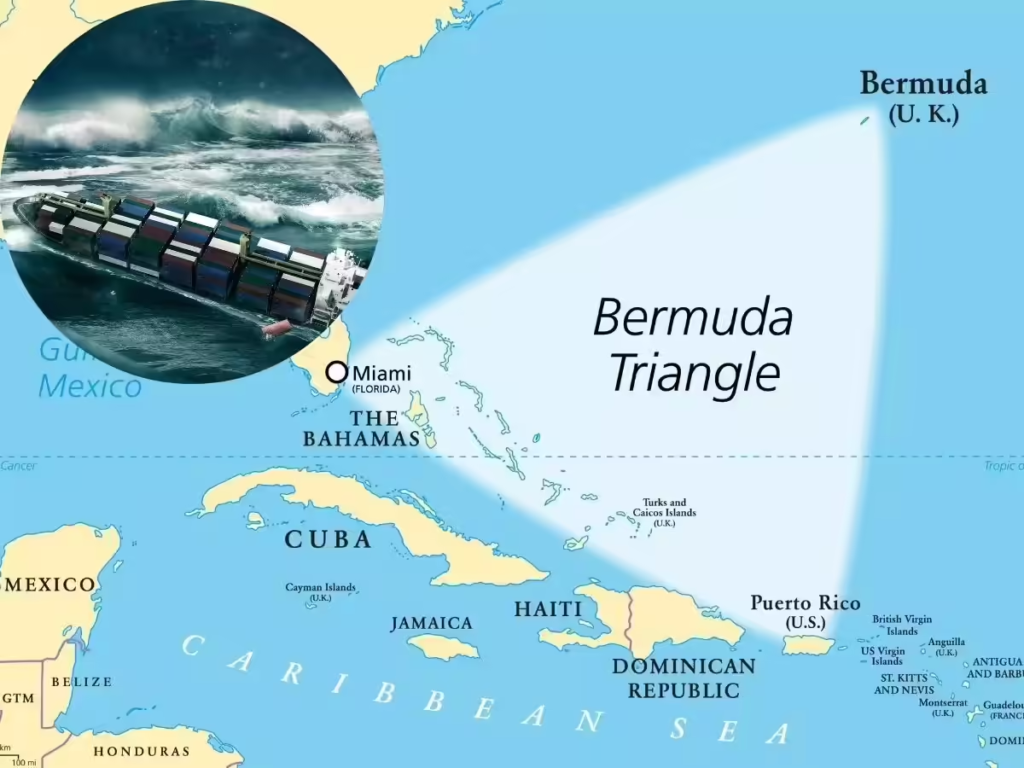
The Bermuda Triangle, also known as the Devil’s Triangle, is a loosely defined region in the western part of the North Atlantic Ocean. It is generally bounded by Miami (Florida), Bermuda, and San Juan (Puerto Rico), covering nearly 500,000 square miles of ocean.
This vast region includes the Straits of Florida, parts of the Bahamas, the Caribbean islands, and the Atlantic Ocean extending eastward. Despite its mysterious reputation, it is one of the busiest shipping lanes and flight routes in the world. Every year, thousands of commercial ships, military vessels, fishing boats, private yachts, and aircraft safely travel through the region.
However, the area is naturally challenging. Powerful ocean currents, deep underwater trenches, unpredictable weather, and frequent tropical storms make navigation difficult even for experienced sailors and pilots.
How Did the Legend Begin?
Although unusual events in the region date back centuries, the modern legend began during the twentieth century.
Some historians believe the earliest strange observations were made by Christopher Columbus, who reportedly noted unusual compass readings while sailing through the Atlantic. However, these observations alone did not create the mystery.
The phrase “Bermuda Triangle” was first coined by Vincent Gaddis in 1964 in Argosy magazine while discussing the disappearance of Flight 19. Earlier, in 1950, journalist Edward Van Winkle Jones had published an article describing mysterious disappearances in the region. As newspapers, magazines, books, and television programmes continued to report similar stories, the Bermuda Triangle gradually became one of the world’s most famous unsolved mysteries
.
Flight 19: The Incident That Defined the Mystery
No incident contributed more to the Bermuda Triangle legend than the disappearance of Flight 19.
On 5 December 1945, five U.S. Navy TBM Avenger bombers departed from Florida on a routine training mission. Initially, weather conditions were favourable, but during the flight, the squadron leader reported that his compasses were malfunctioning and that he was uncertain of his exact location.
As fuel supplies decreased, radio communication became increasingly confusing before finally disappearing altogether. A rescue aircraft sent to search for Flight 19 also vanished shortly after takeoff.
Despite one of the largest search operations of its time, no confirmed wreckage of either Flight 19 or the rescue aircraft was ever recovered. This mysterious event became the foundation of countless theories surrounding the Bermuda Triangle.
Modern investigators believe that navigational confusion, worsening weather, strong winds, and fuel exhaustion were the most likely causes of the tragedy.
Other Famous Disappearances
Flight 19 was not the only incident associated with the Bermuda Triangle.
Perhaps the most famous maritime disappearance was that of USS Cyclops, a massive U.S. Navy cargo ship carrying over 300 people. In 1918, the vessel disappeared without sending a distress signal, making it one of the largest non-combat naval losses in American history.
Other vessels and aircraft frequently linked to the Bermuda Triangle include:
- SS Marine Sulphur Queen
- SS Cotopaxi
- Carroll A. Deering
- Witchcraft
- Sandra
- Star Tiger
- Star Ariel
Each disappearance occurred under different circumstances. Some were caught in storms, others experienced mechanical problems or communication failures, while several simply lacked enough evidence to determine exactly what happened.
Scientific Explanations Behind the Mystery
Although supernatural theories receive the most attention, scientists have proposed several natural explanations.
Severe Weather
The Bermuda Triangle experiences rapidly changing weather conditions. Hurricanes, tropical storms, thunderstorms, waterspouts, and strong winds frequently develop in the region, often with little warning. Before the development of modern weather forecasting, ships and aircraft could easily become trapped in dangerous conditions.
The Gulf Stream
One of the strongest ocean currents in the world, the Gulf Stream, flows directly through the Bermuda Triangle. Its fast-moving waters can quickly carry away floating wreckage, making search and rescue operations extremely difficult and leaving little evidence behind.
Deep Ocean Floor
Nearby lies the Puerto Rico Trench, one of the deepest parts of the Atlantic Ocean, reaching depths of more than 8,000 metres. If ships or aircraft sink in such deep waters, recovering wreckage becomes extremely challenging.
Compass Variations
Stories of spinning compasses have fuelled many theories. Scientists explain that Earth naturally has differences between magnetic north and true north, requiring navigational corrections. Although these variations may confuse inexperienced navigators, no unique magnetic anomaly has been found that exists only within the Bermuda Triangle.
Methane Gas Theory
Another scientific hypothesis suggests that methane gas trapped beneath the ocean floor may occasionally escape, reducing water density and potentially causing ships to lose buoyancy. Rising methane could also interfere with aircraft engines. While methane hydrates exist beneath some ocean floors, researchers have found little evidence that they occur frequently enough in the Bermuda Triangle to explain most disappearances.
Human Error and Mechanical Failure
Experts agree that human error remains one of the most common causes of accidents at sea and in the air. Navigational mistakes, equipment failures, poor communication, and unexpected technical problems have contributed to many incidents that were later described as mysterious.
Theories That Captured People’s Imagination
The lack of complete answers gave rise to countless extraordinary theories.
Some believe that Atlantis, the legendary lost city, lies beneath the Triangle and that its mysterious energy crystals interfere with navigation.
Others suggest that UFOs or underwater alien bases are responsible for the disappearances.
One of the most popular theories involves a time vortex or electronic fog. In 1970, pilot Bruce Gernon claimed that while flying near Bimini Island, he entered a strange tunnel-like cloud filled with bright flashes of light. According to his account, he emerged much farther away than expected in only a few minutes. Although this story fascinated many people, later scientific analyses suggested that unusual atmospheric conditions, solar activity, and navigational confusion may explain his experience.
Additional theories have blamed secret government experiments, interdimensional portals, electromagnetic energy fields, pirates, and even the impact of an ancient comet. Despite their popularity, none of these explanations has been supported by reliable scientific evidence.
Science vs. Myth
In 1975, researcher Larry Kusche carefully examined many Bermuda Triangle cases. His investigation revealed that numerous reports contained exaggerations, factual errors, or omitted important details. He concluded that the number of accidents within the Bermuda Triangle was not significantly greater than in other heavily travelled parts of the world’s oceans.
Modern organisations, including the U.S. Coast Guard and the National Oceanic and Atmospheric Administration (NOAA), do not recognise the Bermuda Triangle as an unusually dangerous region. Advances in satellite navigation, GPS, sonar mapping, and weather forecasting have greatly improved safety and understanding of the area.
Scientists generally agree that the Bermuda Triangle is not uniquely mysterious but is instead a region where natural hazards combine with heavy air and sea traffic.
Why Does the Mystery Continue?
If science has explained so much, why does the Bermuda Triangle continue to fascinate people?
The answer lies in human curiosity. People are naturally drawn to mysteries, especially those involving the vast and unexplored ocean. Sensational newspaper reports, bestselling books, documentaries, and films transformed isolated accidents into a legendary mystery. Every new disappearance seemed to strengthen the myth, even when ordinary explanations existed.
Moreover, not every historical case has been completely solved. The absence of conclusive evidence allows speculation to survive, keeping the legend alive for each new generation.
Conclusion
The Bermuda Triangle is a remarkable example of how history, science, and folklore can become intertwined. Real disappearances, tragic accidents, and unanswered questions created the foundation of the legend, while media attention and imaginative theories turned it into a worldwide phenomenon.
Scientific research has shown that powerful storms, strong ocean currents, deep waters, navigational challenges, mechanical failures, and human error can explain many of the incidents associated with the region. At the same time, a few cases remain unsolved simply because evidence has never been found.
So, is the Bermuda Triangle a mystery, myth, or misunderstanding? The answer lies somewhere in between. It is a place where genuine historical mysteries exist but where myths have often grown far larger than the facts. Ultimately, the Bermuda Triangle reminds us that the greatest mysteries are not always supernatural—they often arise from the limits of human knowledge and our endless curiosity about the unknown.
-Charvi Jain
MUST READ: FIFA World Cup: The Ultimate Power Tournament That Defines Global Football Glory
