
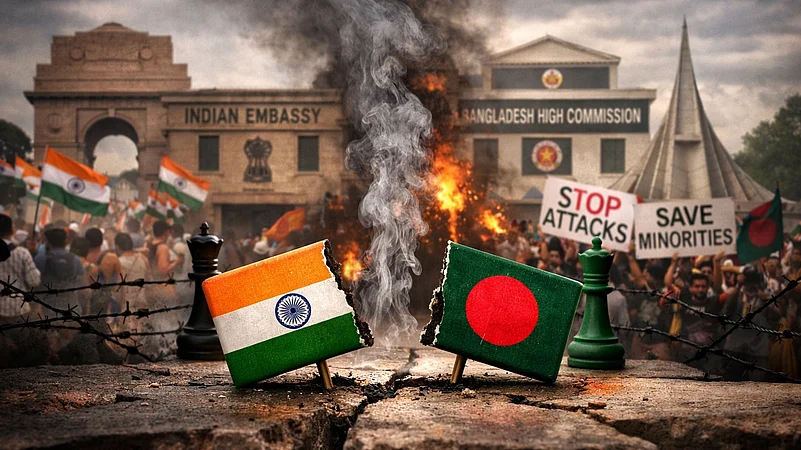
Bangladesh Unrest 2025Political Explosion: Gen Z Protests Ignite Crisis
Unrest in Bangladesh in 2025 can be traced back to the 2024 quota protests that led to the overthrow of Sheikh Hasina, and in fact, the situation there turned sour again in December after the killing of student leader Sharif Osman Hadi. It is also due to the interim government’s “July National Charter” that the people once again took to the streets. Large-scale demonstrations have been occurring in Dhaka demanding justice for the killing of Sharif, reform of the quota system, and the holding of elections.
Police have responded to these protests with attacks, and as a result, there has been the setting of fires, imposition of curfews, and border mobilization. Such happenings exemplify how, to a great extent, the youth who make up the bulk of the Bangladesh unrest 2025 are disillusioned with the elite pacts, which they see as a continuation of the same old tradition of no accountability for the past.
The interim leader, Muhammad Yunus, is feeling the heat of the Bangladesh unrest 2025 and is increasingly finding it hard to keep the balance between students’ demands and Awami League counterprotests. Besides the aforementioned, there is also the increasing influence of Islamist groups such as that of the Jamaat-e-Islami, whose release from prison is a source of worry for the neighbors. Human Rights Watch reports a pattern of violations and urges that the unrest in Bangladesh in 2025 poses a serious threat to the already unstable situation of the 2026 elections, which are expected to be held soon.
Violence Spiral: Clashes, Curfews, and Casualties
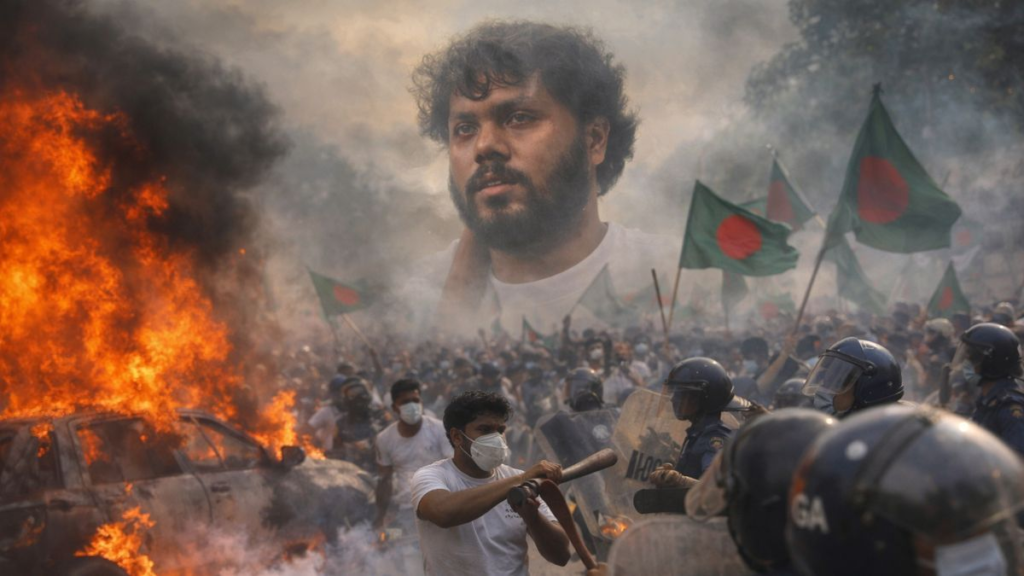
The December Bangladesh unrest 2025 escalated immediately after Hadi was shot, as the demonstrators set ablaze police vehicles and media offices and also stormed the Parliament area. They were answered by tear gas and stun grenades from the police. Dhaka was covered by curfews as border guards were seen protecting the diplomatic areas including India’s High Commission due to the fear of the situation getting out of hand. The UN urged the people to calm down, comparing the Bangladesh unrest 2025 to the 2024 crackdown that resulted in 1,400 deaths in 46 days.
During the Bangladesh unrest 2025, communally, the Hindu population, who are considered as the allies of the Awami League, have been attacked more and more with their temples and homes being targeted and a revival of the 1971 secularism debates as well as a rise in the minority’s exodus being the result of it. The social rift escalates the Bangladesh unrest 2025 to cross the political sphere and become a struggle for the very existence of the people’s identity.
Seven Sisters Threat: Northeast India on Edge
Bangladesh unrest 2025 escalated dramatically when Hasnat Abdullah, the leader of the National Citizen Party (NCP), threatened to “cut off the Seven Sisters” if India interfered in Dhaka and said that his party would provide shelter to the separatists of the Northeast. At Shaheed Minar, he declared that isolating Arunachal Pradesh, Assam, Manipur, Meghalaya, Mizoram, Nagaland, and Tripura—the four states bordering Bangladesh—would be a way of warning Delhi against destabilizing Dhaka and also a reference to the 1990s when insurgents used to take refuge in these areas. India invited Bangladesh’s High Commissioner to discuss the “deteriorating security environment” and protest the same.
The rhetoric of the Bangladesh unrest 2025 situation has had a negative impact on security agencies, who are worried about the fact that the borders are not well-guarded and that several camps of ULFA and NDFB were established in that area in the past. The resurgence of the Jamaat-ul-Mujahideen Bangladesh (JMB) is raising concerns over the infiltration of jihadists in the Chicken’s Neck corridor. There have been more reports of violence in Assam as a result of the Bangladesh unrest 2025 which has been used by jihadists to instigate anti-India and pro-jihad narratives.
Indian Leaders’ Fiery Responses to Bangladesh Unrest 2025 Threats
Assam CM Himanta Biswa Sarma didn’t mince words when he responded to Hasnat Abdullah’s “Seven Sisters threat,” labeling it as “irresponsible and dangerous.” He promised that India “will not remain silent” and pointed out that the Northeast is very much a part of this “nuclear-powered economy.” Sarma accused Yunus of distorting maps to show the Northeast as part of Bangladesh and called on Delhi to make a strong and firm response amid the unrest in Bangladesh 2025.
Northeast protests at the Bangladesh missions in Agartala demanding border closure. The leaders of Tripura and Mizoram, reacting to the security alerts, also spoke about the necessity of tightening the border. PM Modi’s government reacted to the situation by calling in envoys and closing visa centers in Khulna and Rajshahi, thus letting the neighbors know that it is a case of zero tolerance. The unrest in Bangladesh 2025 is the reason for the 4,096 km long border that is at risk.

Bangladesh Unrest 2025 Strains India-Bangladesh Strategic Ties
Hasina’s India exile fuels Bangladesh unrest 2025 anti-India chants disrupt the demand for extradition, closing down connectivity like the Akhaura-Agartala rail, which was a dream for trade amid the halts. Delhi is concerned that the Bangladesh unrest 2025 will be used by Pakistan/China to gain influence as the Islamist forces grow in Bangladesh. India closed consulates, citing threats, raising controversial issues of minority protection and refugee influx.
Bangladesh unrest 2025 endangers the Siliguri Corridor disruptions, hydropower agreements, and Bay of Bengal collaboration; New Delhi is encouraging dialogue but is also ready for contingencies. The bilateral trade volume is at $14B and is very unstable.
Bangladesh Unrest 2025 Regional Fallout and Path Forward
Bangladesh unrest 2025 has allowed China to expand its Belt and Road network into the region and given Pakistan a chance to avenge, thereby making the Indo-Pacific balance more complex. The United Nations investigates the previous repression while Dhaka is rejecting India’s démarche; thus, the diplomatic freeze is getting deeper. Youth movements are calling for reforms; however, the risk of the elite prolonging the Bangladesh unrest 2025 still exists.
Bringing back the peace in the region requires justice, guarantees for the minorities, and calming down at the border; India supports democratic elections and at the same time is strengthening the security in the Northeast against the possible spillover of the Bangladesh unrest 2025. If there is a failure, there will be proxy wars, refugee crises, and economic corridors that will be lost.
-RITOBROTA BANERJEE
MUST READ: The Unseen Power of Music Therapy: Healing Frequencies for Emotional Well-being
