
What the NEET Paper Leak 2026 Was
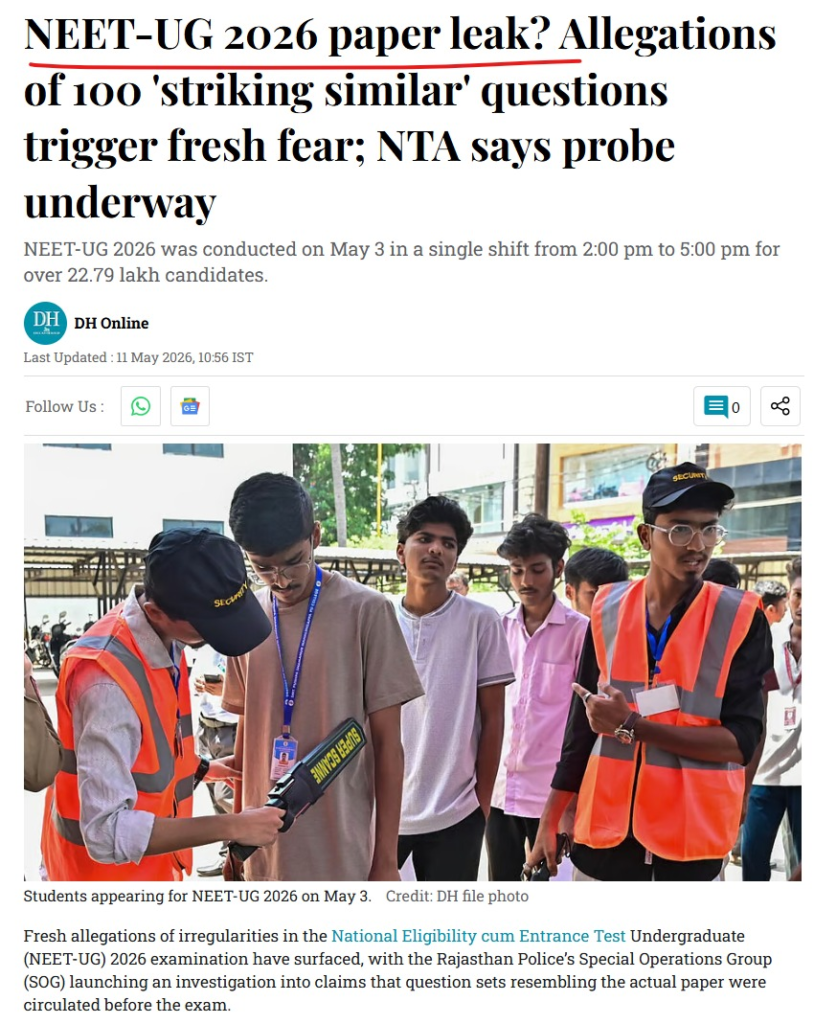
The NEET paper leak 2026 began when a “guess paper” or practice set doing the rounds on WhatsApp groups and PDF‑sharing platforms was found to match a significant number of questions in the actual NEET UG exam. A teacher from Rajasthan’s Sikar district reportedly compared the circulating document with the official question paper and found that 45 chemistry questions and around 90 biology questions were almost identical. This was not a minor coincidence; it strongly suggested that the NEET paper leak 2026 had reached a network many steps beyond the exam‑conducting body.
For students, the NEET paper leak 2026 meant that some candidates had likely seen at least a portion of the paper in advance, distorting the level playing field the exam was supposed to ensure. Those who had prepared honestly, often for years, suddenly felt that their hard work had been undermined by a hidden network of leaks and digital image‑sharing. The NEET paper leak also revived the trauma of the 2024 paper-leak episode, convincing many that the system had not learned the right lessons between cycles.
How the Leak Was Exposed and Investigated
The NEET paper leak 2026 controversy exploded when the Rajasthan teacher alerted authorities and shared his detailed comparison of the leaked PDF with the official NEET paper. His analysis went viral, putting pressure on the National Testing Agency (NTA) and the Ministry of Education to respond quickly. The NEET paper leak story gained national traction not only because of the scale of matching questions but also because of social media videos and screenshots shared by students who claimed to recognize the leaked content.
Investigations were taken up by the Rajasthan Police Special Operations Group (SOG) and later the Central Bureau of Investigation (CBI), which traced the NEET paper leak trail across multiple states, including Punjab, Kerala, and Uttarakhand. Suspects linked to coaching‑related counselling offices, “Paying‑Guest” networks, and digital‑sharing circles have been arrested, questioned, or raided. The probe has shown that the NEET paper leak 2026 was not an isolated hack but a worrying pattern of security failure in India’s high‑stakes entrance‑exam infrastructure.
Why the Government Cancelled NEET 2026
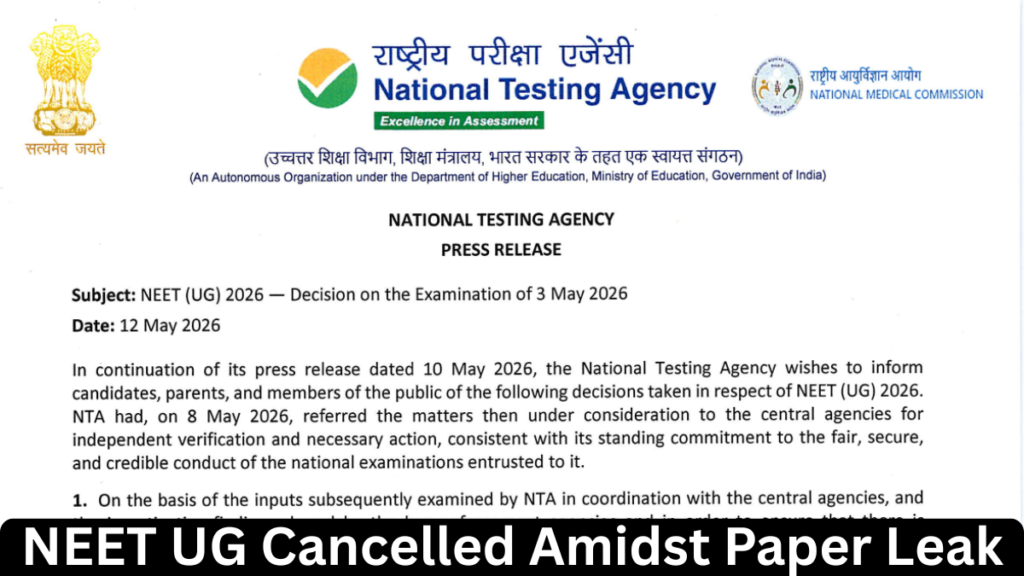
The NEET paper leak 2026 made it politically and legally impossible to treat the first attempt as a fair, legitimate exam. The government faced immense pressure from student‑groups, parents, opposition parties, and even the judiciary, who argued that allowing the original results to stand would be a direct betrayal of merit and public trust. In response, the Centre and the NTA announced the cancellation of NEET 2026 and committed to conducting a retest, a rare move that reflects how deeply the NEET paper leak had corroded the exam’s credibility.
Cancellation also carried symbolic value: it sent a message that such a leak would not be swept under the carpet. For millions of students, the retest meant a second chance, but it also implied extra stress, uncertainty, and disrupted preparation routines. The 2026 chapter became less about a single‑day performance and more about a long, emotional roller‑coaster shaped by the NEET paper leak and the government’s response to it.
The Retest: Logistical, Psychological, and Academic Impact
The retest for NEET 2026 is not simply a repeat of the same exam; it is a massive logistical operation that must resecure question papers, invigilation, and digital monitoring systems to avoid a repeat of the NEET paper leak. The NTA and state authorities have had to reset printing‑centers, center‑allocation, and personnel‑deployment, all while maintaining the same eligibility‑criteria and fairness‑principles. The stakes of getting the retest right are high, because another failure would deepen the NEET paper leak–induced crisis of trust.
Beyond logistics, the retest has a heavy psychological burden on students. Many who had already written the original exam once are now forced to re‑revise, re‑facing the same stress, fear of failure, and health‑risks that had already taken a toll. The 2026 retest is thus as much a mental‑health test as an academic one. The NEET paper leak 2026 experience has made candidates and parents unusually sensitive to rumors, confusion, and last‑minute changes, making the retest phase even more fragile than a regular exam cycle.
Political and Public Backlash Over the NEET Paper Leak
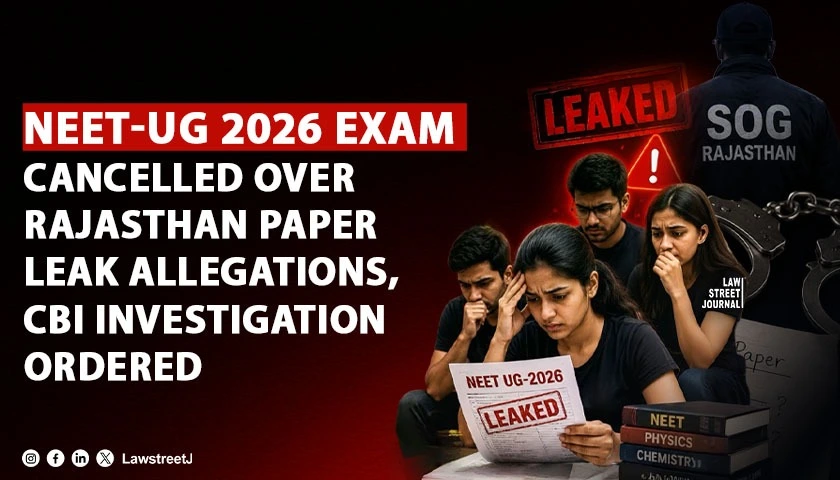
The NEET paper leak of 2026 quickly became a national-level political flashpoint. Opposition parties attacked the NTA and the education ministry, framing the NEET paper leak as a sign of systemic failure, negligence, and insider collusion with coaching mafias and profit centers. Protests were held in multiple states, with students demanding compensation, age relaxation, and stronger safeguards for future exams. The leak exposed how deeply anxiety and hope were tied to the NEET paper leak episode for families across different income‑strata.
In the public‑discourse, the NEET paper leak 2026 is now often cited as a warning‑case about what happens when high‑stakes exams are centralised, opaque, and exposed to digital‑vulnerability. The government’s response—ordering the retest and backing a CBI‑level investigation—suggests that it recognises the reputational cost of the NEET paper leak, but the long‑term impact on the medical‑education‑system’s image will depend on whether such a leak ever happens again in future years.
Reforms Needed After the NEET Paper Leak 2026 Retest
The NEET paper leak 2026 and the subsequent retest should be the last chapter in a cycle of repeated failures, not just another episode in the same tired pattern. Experts argue that the 2026 crisis demands a complete overhaul of the NEET paper leak‑prone architecture: tighter digital‑security, random‑question‑pool generation, multi‑shift‑paper‑rotation, and stricter penalties for breach‑of‑confidentiality. The NEET paper leak incident has shown that once the digital barrier is compromised, the exam’s integrity collapses in seconds.
For students, the 2026 chapter is also a call for better mental‑health support, clearer communication from the NTA, and transparent re‑evaluation mechanisms during the retest phase. The NEET paper leak and the retest experience may ultimately push India to treat competitive exams not only as tools of selection but also as systems that must protect the well‑being and dignity of the young people who depend on them. The 2026 scandal, therefore, is not just a scandal; it is a turning point that can either trigger genuine reform or normalize repeated failures in the NEET paper leak era.
-RITOBROTA BANERJEE
MUST READ: Captivating Depressed Nihilist Penguin: Viral Internet Phenomenon
